

I don’t write to you for ages and now you’re hearing from me twice in the space of a week! But, in my defence, I have finished two great things, in (you guessed it), the space of a week.
First up is the podcast I mentioned last week, Blood Relatives, by Heidi Blake. If you pay for nothing else this month, please let it be this. I am so desperate to talk about it with people. The series will conclude next Tuesday 25th Nov so you could also wait. This podcast, which isn’t really an accurate thing to call it, is such a fascinating piece of investigative reporting, about the 1985 White House farm murders in Essex. There are so many outrageous details, so many twists and turns and blatant lies that it is astounding.
Second, and which is more why I’ve posted again so soon is that I bought (and finished, just last night), The Mushroom Tapes by Helen Garner, Chloe Hooper and Sarah Krasnostein (courtesy of reading Jessica Stanley’s excellent newsletter which you need in your lives). This is a book about the murder that took place in 2023, by Erin Patterson, who hid death cap mushrooms in a beef Wellington dish which she fed to extended family members. The book, originally intended as a podcast, cleverly weaves together the perspectives of the three authors as they attend the trial and sentencing, earlier this year.
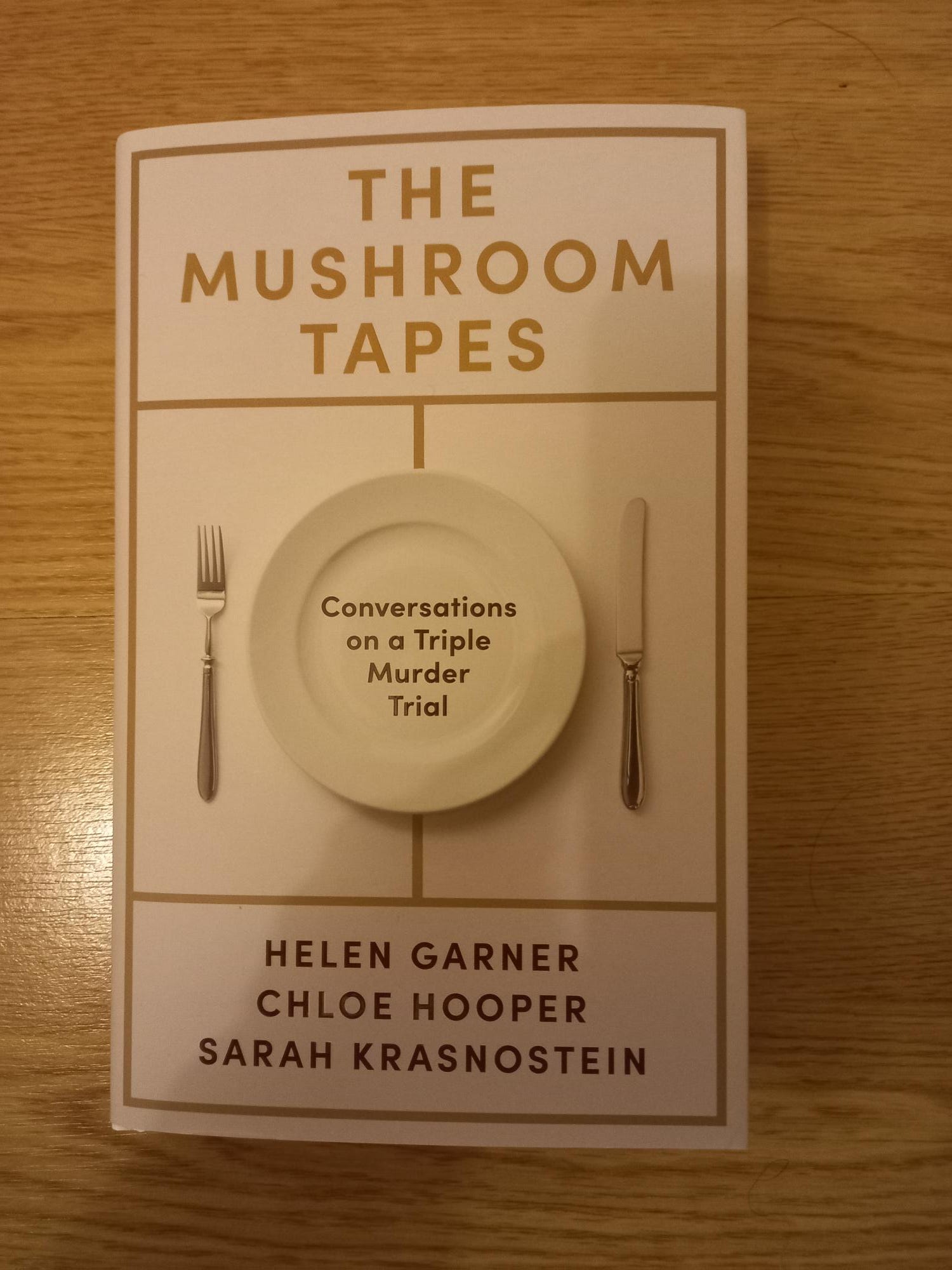
This book is incredible for the following reasons:
(1) It considers our broader, societal obsession for true crime. Take this excerpt, for example:
“But I want to know more about true crime’s appeal to women. I read that something like seventy per cent of Amazon’s true crime book reviews are by women, whereas for war books it’s like eighty-two per cent men. A female audience is driving the production of true crime in every medium. Why are women so fascinated by this?
[…]
But there’s another theory: women are listening to or reading or watching true crime because they recognise themselves in these stories as, unfortunately, the victims- most often- and they’re almost trying to game out: How do you not pick the sociopath on Tinder? Just as fairy stories are cautionary tales, you know, you shouldn’t hitchhike along a dangerous road in the middle of the night, or you shouldn’t-.” (p. 54)
Yes- it is this idea that by knowing what not to do, we can protect ourselves, and be guaranteed that we surely wouldn’t make the same ‘mistake’ as those who end up less fortunate…as if this is down to choice and freewill!
(2) It is a fascinating creative endeavour. Take the way each author would start the book differently. I love how they each get their beginning, as part of a broader narrative:
Helen: “Breathes there a wife with soul so dead, who never to herself hath said, I’ll kill them all and run away.”
Chloe: “In every house, in every street along the M1, lives someone who knows the feeling of love gone wrong.”
Sarah: “Twenty-two months after she served her lunch guests beef Wellington, the distinctive orange plate off which Erin Patterson had eaten came spinning out of the past like a frisbee and landed in front of the jury considering her murder charges.”
(3) It is beautiful and jarring in how it moves from depth to superficiality in one breath. Take this example:
“Helen: Oh, you had a look, did you? It’s hard to capture the spooky feeling of dreams. They’re like a little jet from the unconscious that shoots up something raw. To ignore them seems to me ungrateful to your psyche. What are we doing to do about breakfast?” (p.113)
For me, the draw of true crime is the hunt for evidence. It is about how pieces of the puzzle fit together to form ‘truth’, but also how that ‘truth’ is always polyvocal. Miscarriages of justice terrify me- how can you prove innocence when there are people and systems intent on proving guilt (i.e. Amanda Knox).
What I’m completely against in true crime is any type of glorification and indeed gorification (yes, I did just make up this word, but it works, I think). This frankly, should be banned (e.g. the recently released Monster, which kept popping up on my Netflix banner, and disturbed me so much after I looked up what it was about that I now can’t unknow the details of this man’s heinous crimes).
There is also the complexity of consent and voice- who gets to tell the story of murder, how, why and with what permission. Take for example the documentary put together from predominately police bodycam footage, My Perfect Neighbour, about a neighbourhood dispute which ends with the killing of Ajike Owens which certainly feels like some scenes should have remained private (i.e. when the children of the deceased mother are informed, on camera).
Who gets a say in this and with what permission? And what is our role in this as viewers and consumers?